


Guitar Lessons in Antalya in English: A Guide for Expat Adults

If you live in Antalya and want guitar lessons in English as an adult, the short version is this: book one-to-one lessons with a teacher who actually teaches in English, choose the guitar type that matches the music you want to play, fix one weekly lesson time like a work meeting, and practise a little every day rather than a lot once a week. This guide explains each step, what to expect in the first months, which Turkish words are useful in a Turkish music school, and how lessons work at Artistik Stüdyo in Lara.
Short answer
Who this is for: adult expats, digital nomads, retirees and long-stay visitors in Antalya who want to start, restart or improve on guitar, with lessons explained in English.
Lesson format: one-to-one lessons work best for adults because the pace follows your schedule, your hands and your musical taste.
Which guitar: classical (nylon strings), acoustic (steel strings), electric or bass. Pick the one that sounds like the music you want to play.
First step at Artistik Stüdyo: a free 15-minute consultation where your goals, level and schedule are discussed and the fee is set.
Language: one of our teachers gives lessons in English, and guitar is one of their subjects. Our coordinator also speaks Russian.
Why so many adults look for guitar lessons in Antalya
Antalya has one of the largest international communities in Turkey. According to data from the Turkish Presidency of Migration Management (Göç İdaresi Başkanlığı, GİB) dated 3 September 2026, 150,286 foreign nationals held a residence permit in Antalya, the second-highest figure after Istanbul and almost twice Ankara's.

Source: GİB data dated 3 September 2026, as published by Göç Araştırmaları Vakfı (Temmuz–Ağustos 2026 Göç Trendleri).
Many of those residents are adults who finally have time for something they postponed for years. The problem is practical: most local search results, course pages and price lists are in Turkish, and it is hard to tell from a website whether a teacher can explain technique clearly in English. A guitar lesson is full of small instructions ("relax your thumb", "lift the third finger later", "mute that string"), so a shared language matters more than in many other hobbies.
What adult beginners want from the guitar
If you are wondering whether you are "too old" or "not musical enough", you are in large company. In 2018 Fender commissioned a survey of 500 aspiring and beginning guitar players in the US and the UK, carried out by the research firm Egg Strategy. Women made up 50 percent of beginner and aspirational players. The reasons people gave for picking up the guitar were mostly personal, not professional:

Source: Fender press release "Guitar Isn't Dead" (PR Newswire, 16 October 2018), survey by Egg Strategy, 500 respondents in the US and UK.
The same research also explains why many beginners stop. Nearly half of the beginners said they had quit an instrument because of time constraints, and 33 percent said they were not improving as fast as they expected. Fender's CEO Andy Mooney said the company had found that more than 90 percent of first-time players abandoned the guitar within 12 months, often in the first 90 days, while those who kept going tended to stay with the instrument for life. Those figures come from the US and UK market, not from Antalya, but the lesson for any adult learner is the same: plan for limited time and realistic progress from day one.
Step 1: Choose the right guitar for the music you like
Adults often buy the cheapest guitar in the shop and then wonder why it feels uncomfortable. A better question is: what do you want to play in six months? Use this list as a starting point:
Classical guitar (nylon strings): softer on the fingertips and suited to classical, flamenco-inspired, bossa nova and fingerstyle pieces. The neck is usually wider, which some adults like and some find a stretch.
Acoustic guitar (steel strings): the sound of singer-songwriters, campfire songs and strumming pop. Steel strings feel harder at first, but the fingertips adapt within a few weeks of regular practice.
Electric guitar: for rock, blues, funk and indie. Lighter strings and a slimmer neck make chords easier, but you also need an amplifier or headphones amp.
Bass guitar: if you love grooves and want to join a band quickly, bass is a very social instrument.
We compare classical and electric guitars in detail, with real neck and string measurements, in our Turkish-language guide Elektro gitar mı klasik gitar mı? (your browser's translate button works well on it). If you do not own a guitar yet, our sister company Ezgican Müzik can help you choose one that fits your hands and your budget, so it is worth waiting for your first consultation before you buy.
Step 2: Pick a lesson format that survives a busy life
For most adults the biggest risk is not talent but the calendar. The formats below are available at Artistik Stüdyo:
One-to-one lessons in Lara: all instrument lessons are private. The teacher can slow down, repeat, and switch songs when something does not suit you.
Online VIP lessons: if you travel, work long hours or spend part of the year outside Antalya, online one-to-one lessons let you continue with a live teacher from anywhere.
Sunday group workshop: students on a one-to-one package can join the Sunday 13:30 group workshop on solfège and song reading, a relaxed way to learn rhythm and pitch with other people.
Studio goal: recording one song in a real recording studio gives adults a clear target, and the studio is in the same building.
Step 3: Learn a little Turkish music vocabulary
Your lessons can run in English, but you will see Turkish words on sheet music, apps, shop labels and the school's notice board. Turkey uses the fixed "do-re-mi" note names alongside the English letter system, so you may hear "Do" for C, "Re" for D and "La" for A. These Turkish words are useful to recognise:
Gitar – guitar; tel – string; perde – fret
Akor – chord; akort – tuning (note the one-letter difference)
Pena – pick (plectrum); kapo – capo
Nota – note or sheet music; ritim – rhythm
Sağ el / sol el – right hand / left hand; ders – lesson
Speaking of tuning: in standard tuning the strings, from thickest to thinnest, are E, A, D, G, B and E (in Turkish: Mi, La, Re, Sol, Si, Mi). The lowest string vibrates at about 82.41 Hz and the highest at about 329.63 Hz, exactly two octaves apart. A free tuner app on your phone is the first tool you will need.
Step 4: Practise in a way that fits adult life
In the same Fender release, neuroscientist Daniel Levitin advised beginners to play their favourite songs for five minutes a day, every day, at the same time of day, rather than two hours on a single day. That matches what teachers see with busy adults. A simple routine that works:
Keep the guitar out of its case, on a stand, where you see it every day.
Tune first (one minute), then warm up with one finger exercise (two minutes).
Practise the one thing your teacher marked as this week's priority, slowly, with a metronome.
Finish with something fun: a song you love, even if only the chorus.
Once a week, record a short phone video. Comparing week 1 with week 8 is the best motivation there is.
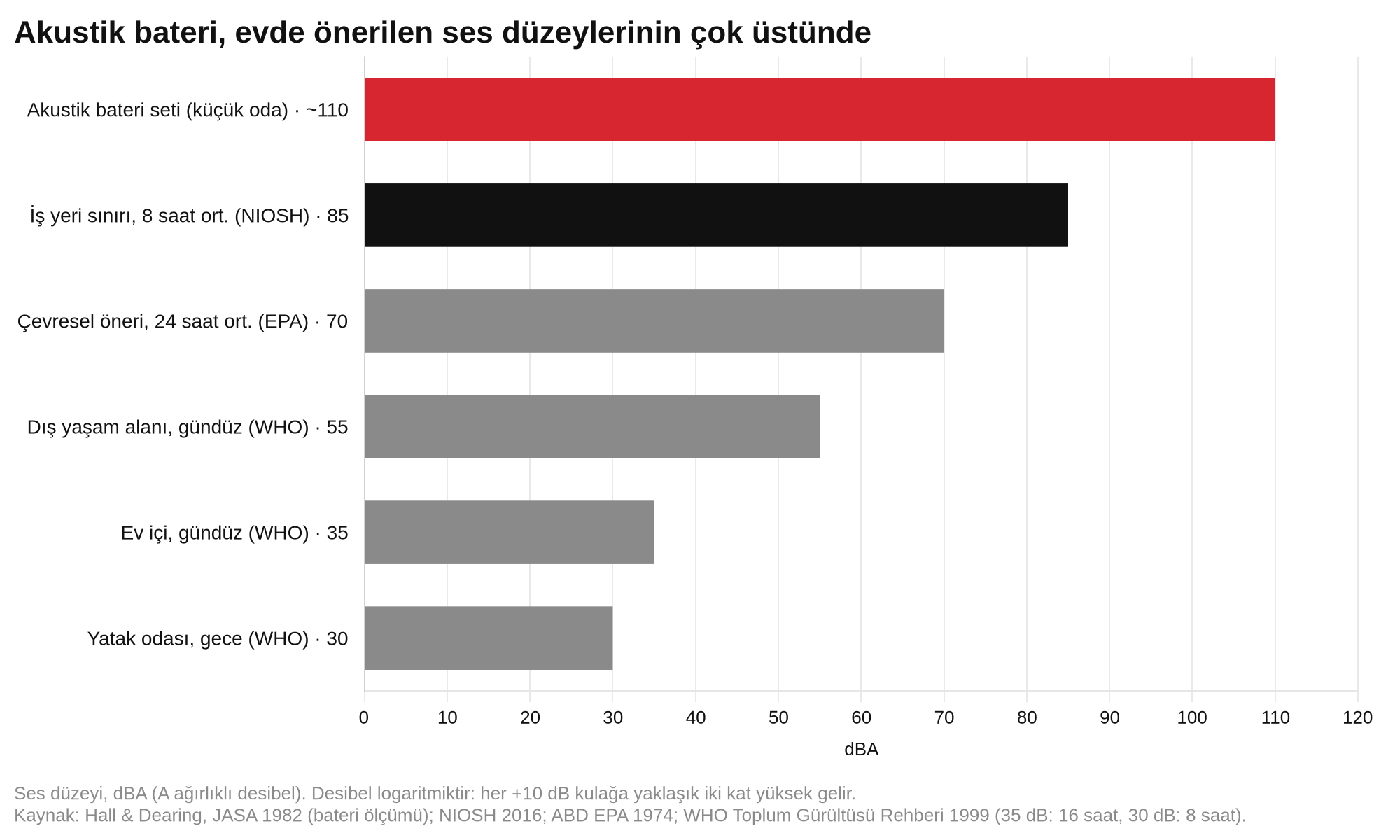
Many expats live in apartments. Acoustic guitar is usually fine at normal hours, and an electric guitar with headphones is almost silent. If you want to play loud with friends, Artistik Stüdyo also has a rehearsal room you can book by the hour.
What to expect in your first three months
Every learner is different, so treat the following as an example plan for an adult beginner taking one lesson a week, not a promise. Your teacher will adjust it to your guitar type, your goals and your available time.
Weeks 1–2: posture, holding the guitar, tuning with an app, first single-string exercises.
Weeks 3–4: your first two or three chords, changing between them, a simple strumming pattern.
Weeks 5–8: four-chord progressions, playing along with a backing track, your first complete easy song.
Weeks 9–12: cleaner chord changes, a second strumming or picking pattern, and recording one song you can share with friends or family.
Sore fingertips in the first weeks are normal; they toughen with short daily practice. If something hurts in your wrist or shoulder, tell your teacher, because it usually means posture needs adjusting.
Questions to ask any guitar teacher in Antalya
Whether you choose us or another school, these questions help you compare options:
Will the whole lesson be in English, or only parts of it?
Is the teacher a permanent staff member, so I keep the same teacher every week?
Can I switch between in-person and online lessons when I travel?
Is there a practice or rehearsal space if I cannot play at home?
How is my progress measured: songs, recordings, exams?
Is the course officially licensed? (In Turkey private music courses can be approved by the Ministry of National Education, MEB.)
How it works at Artistik Stüdyo
Artistik Stüdyo is an MEB-approved music and art course in Lara, Muratpaşa, Antalya. Lessons, a recording studio and a rehearsal room are in one three-storey building, and we are open every day from 10:00 to 20:00.
Free 15-minute consultation: we talk about your musical taste, any previous experience and your weekly schedule. Fees depend on the package and are set during this conversation.
Lessons in English: one of our teachers teaches in English; guitar, singing, cello and drums are among their subjects, as well as recording and arrangement.
Full-time teachers: our teachers are full-time staff, so you keep the same teacher week after week.
All guitar types: classical, acoustic, electric and bass. See our guitar lessons page for the programme.
Beyond lessons: the Sunday 13:30 solfège and song-reading workshop for one-to-one package students, an hourly rehearsal room, and a recording studio for your first real recording.
Instrument advice: our sister company Ezgican Müzik helps you choose a guitar.
If you have children who want lessons too, read our guide to music lessons for kids in Antalya. For an overview of all lessons and studio services in English, see Music Lessons in English, Recording Studio & Rehearsal Room in Antalya, or reach us through our contact page.
Frequently asked questions
Can I take guitar lessons in English in Antalya?
Yes. At Artistik Stüdyo in Lara one of our teachers gives lessons in English, and guitar is one of their subjects, alongside singing, cello, drums, recording and arrangement. Our coordinator also speaks Russian.
Am I too old to start learning guitar?
No. Many beginners are adults who want a new life skill: in Fender's 2018 survey of 500 beginners, 72 percent said they picked up the guitar to gain a life skill or for self-betterment. Short daily practice and a fixed weekly lesson matter more than age.
Should I start on classical, acoustic or electric guitar?
Choose the guitar that matches the music you want to play. Classical guitar has softer nylon strings, acoustic suits strumming and songwriting, and electric guitar suits rock and blues. We help you decide during the free consultation.
Do I need my own guitar before the first lesson?
Not for the consultation. It is better to talk to the teacher first; our sister company Ezgican Müzik can then help you choose a guitar that suits your hands and goals.
Can I continue lessons online when I travel?
Yes. Online VIP one-to-one lessons let you keep learning with a live teacher from anywhere, and you can return to in-person lessons in Lara when you are back.
How much do guitar lessons cost?
Fees depend on the lesson package and format, so they are set during the free 15-minute consultation. You can book it on WhatsApp or by phone at 0542 248 69 20.
Sources
Göç Araştırmaları Vakfı – Temmuz–Ağustos 2026 Göç Trendleri (GİB data dated 3 Sep 2026)
Fender – "Guitar Isn't Dead" research release (PR Newswire, 16 Oct 2018)
MusicRadar – 90% of beginner guitar players give up within a year, says Fender (8 Nov 2019)
Wikipedia – Key signature names and translations (fixed-do note names, Turkish)
Ready to start? Book a free 15-minute consultation on WhatsApp or call us.
Last updated: 6 November 2026

Yorumlar